🍽️ Private Food Tour · Authentic Cairo Cuisine · Street Food · No Shopping Stops · Egyptologist Guide
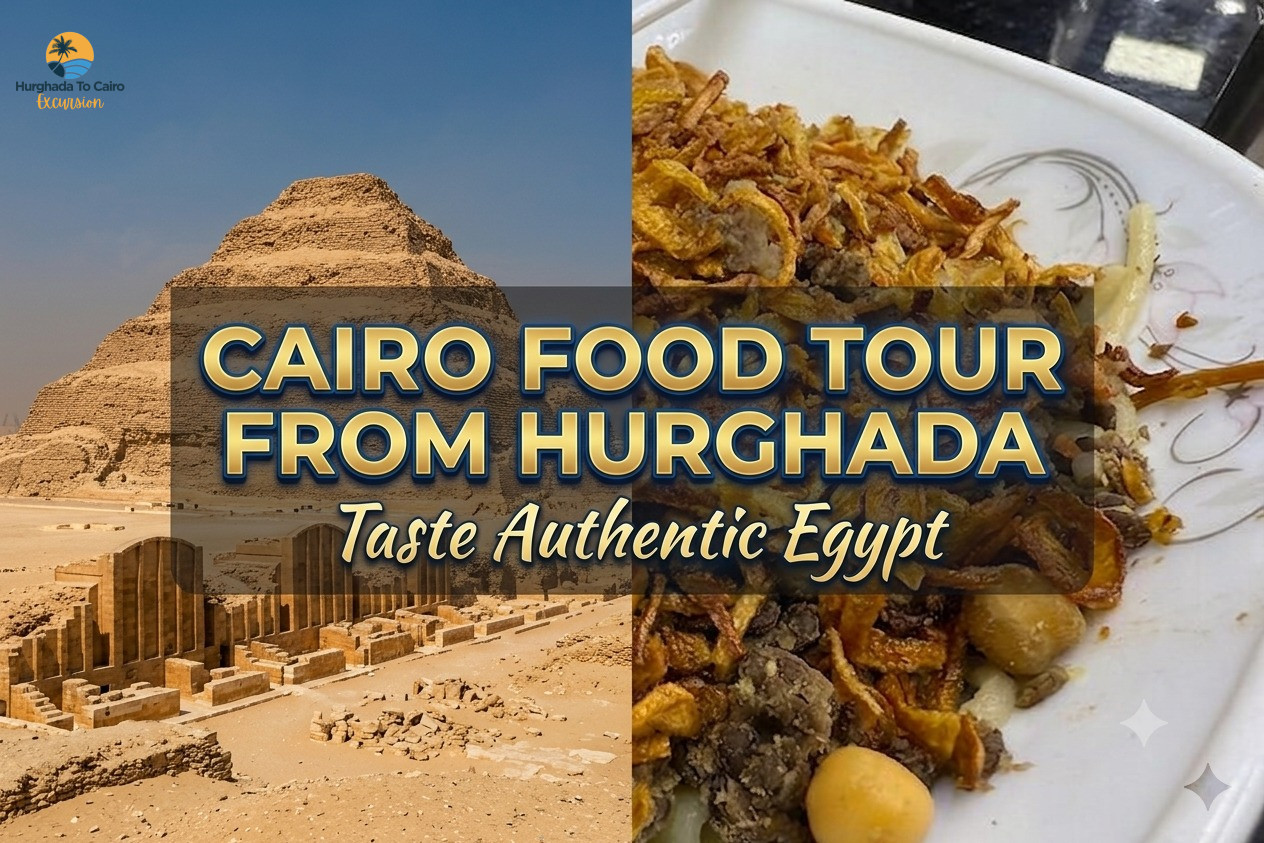
Cairo Food Tour from Hurghada Taste Authentic Egypt
📅 Updated: June 2026 | ⏱️ 19 min read | 💶 From €125 / person | ⭐ 4.9/5 rated | 🍽️ Koshary · Ful Medames · Konafa · El-Fishawy Tea Included
The Cairo food tour from Hurghada is Egypt’s most delicious secret — a private guided journey through the authentic cuisine of one of the Arab world’s greatest food cities, combining the ancient street kitchens of Islamic Cairo, the rooftop restaurants of the Nile, and the legendary establishments where Egypt’s most iconic dishes have been served for generations.
Egyptian food is one of the oldest and most sophisticated cuisines in the Arab world — rooted in 5,000 years of agricultural abundance along the Nile, shaped by Pharaonic, Roman, Arab, Ottoman, and Mediterranean influences, and expressed today through a handful of iconic dishes that define the national identity as powerfully as any monument. Koshary, ful medames, ta’amiya, kushari, konafa, feteer meshaltet — these are the foods that Egyptians grew up eating, that Nobel Prize-winner Naguib Mahfouz wrote about, and that the street kitchens of Khan El Khalili have been producing since the medieval period.
This guide covers everything: the complete hour-by-hour food tour itinerary, the history of Egypt’s most iconic dishes, honest Cairo food tour pricing from Hurghada, what food is Egypt known for, and the story behind the country’s greatest food festival. This is authentic Egypt — tasted rather than photographed.
💡 Why food is the best lens for understanding Egypt: Every dish in the Egyptian culinary tradition carries a social, historical, and agricultural story. Ful medames has been eaten by Egyptians since the time of the Pharaohs — seeds were found in Tutankhamun’s tomb. Koshary is the product of Italian, Indian, and Egyptian culinary collision in the 19th century. Ta’amiya (Egyptian falafel made from fava beans, not chickpeas) is a dish that Cairo has been making differently from every other city in the Arab world for 1,000 years. With a guide who knows the stories, the food tour becomes as much a history lesson as a meal.
Can You Do a Day Trip to Cairo from Hurghada?
Yes — a day trip to Cairo from Hurghada is entirely feasible and is one of the most popular excursions on Egypt’s Red Sea coast. For a Cairo food tour specifically, the day trip format works exceptionally well because the most iconic Egyptian food experiences — the street kitchens of Islamic Cairo, the koshary restaurants of central Cairo, the konafa shops of Khan El Khalili — are all within walking distance of each other in the medieval city.
| Transport |
Journey Time |
Food Stops Time |
Price From |
Best For |
| Private Car |
4.5 hrs each way |
5–6 hrs food + sights |
€125/person |
Best value, flexible |
| By Flight |
40 min each way |
8–9 hrs food + sights |
€315/person |
Maximum food time |
| Shared Bus |
5+ hrs each way |
2–3 hrs (rushed) |
€50/person |
Budget solo travellers |
| 2-Day + Hotel |
Drive Day 1 + Day 2 |
Full evening food market |
€225/person |
Dinner + night market experience |
💡 Best for food specifically: The private car option from €125 delivers an outstanding food tour experience — you arrive in Cairo by 09:00 AM for the morning street food round, enjoy the main food experiences through midday and afternoon, and hit Khan El Khalili‘s dessert shops and El-Fishawy café before the return journey. The by-flight option from €315 gives you 3 extra hours — enough to add a Nile-view restaurant lunch and a full evening street food circuit in addition to the core programme.
How Much Is a Trip from Hurghada to Cairo?
The trip from Hurghada to Cairo costs vary significantly based on transport type, group size, and what is included. Here is the complete 2026 pricing picture for the Cairo food tour from Hurghada and comparable excursions:
€125
Private Car Food Tour
~£107/person · Guide + vehicle + all food stops + drinks included · Your group only
€315
By Flight Food Tour
~£270/person · Return flights + all food + guide · Maximum time in Cairo
€225
2-Day + Hotel
~£193/person · Two full days · 5-star hotel · Food + Pyramids + more
€50
Shared Bus Option
~£43/person · Group tour · 30–45 mins food time only
Price context: The Cairo food tour from Hurghada at €125 per adult includes a licensed Egyptologist guide for the full day, private vehicle, all food stops and tastings at multiple establishments, morning street food circuit, main lunch, afternoon dessert trail, and El-Fishawy café stop. Food is the tour — not an add-on to a sightseeing programme. All dishes described in this guide are covered by your tour price.
What Food Is Hurghada, Egypt Known For?
Hurghada is primarily known as a Red Sea resort destination — its culinary identity is shaped by its coastal location and its international tourist population rather than by deep-rooted Egyptian food traditions. This is exactly why the Cairo food tour from Hurghada is such a revelation for visitors who have been eating at their resort’s international buffet for a week.
🐟
Hurghada’s Speciality: Red Sea Fish
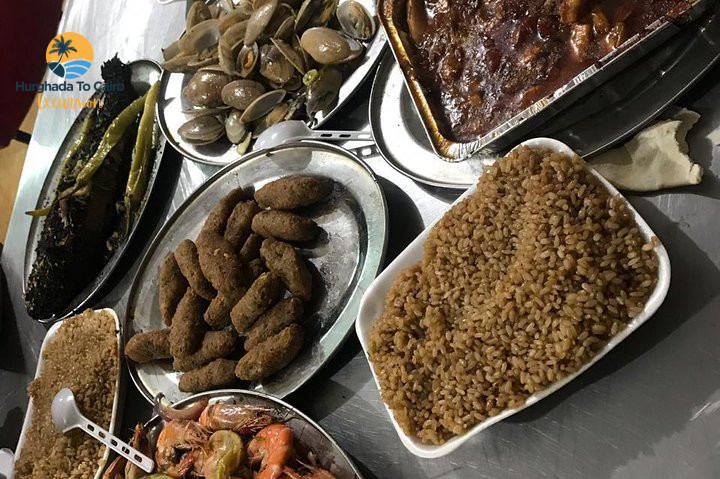
Hurghada is genuinely known for fresh Red Sea fish — sea bream, grouper, red mullet, and calamari grilled over charcoal at the harbour-front fish restaurants. This is the authentic local cuisine of the Red Sea coast: simple, extraordinarily fresh, and quite different from the inland Egyptian tradition your food tour will reveal.
🫘
What Hurghada Lacks: Cairo’s Street Food
What Hurghada does not offer — and what your Cairo food tour will give you — is the deep, complex, historically rooted street food tradition of Cairo: koshary shops that have been serving the same recipe since the 19th century, ful carts that open at 4:00 AM, konafa bakeries that have supplied the medieval bazaar for 400 years.
🥐
Resort Food vs Real Egypt
Most travellers in Hurghada eat exclusively at their resort’s buffet — international food with token Egyptian dishes. This is not Egyptian food. The Cairo food tour from Hurghada replaces the buffet experience with the real thing: dishes eaten by 104 million Egyptians daily, in the places they have always been made.
🌿
Marsa Alam & El Quseir: Bedouin Tradition
Visitors from Marsa Alam and El Quseir encounter an even more specific Red Sea coastal tradition — Bedouin-influenced cooking with slow-cooked lamb, flatbreads from stone ovens, and date-palm products. All the more reason to experience Cairo’s entirely different food culture on this tour.
What Is the Biggest Food Festival in Egypt?
Egypt’s food festival calendar is anchored by two unmissable events — and understanding them reveals a great deal about how Egyptians relate to food as culture, religion, and communal identity.
🌙 Ramadan — Egypt’s Greatest Food Month
The biggest food event in Egypt is not a formal festival but a month-long transformation of the entire country’s food culture during Ramadan. From the first day of Ramadan to the last, Egypt undergoes a culinary revolution: the streets of Cairo fill with Ramadan food markets (mawaid al-rahman — “tables of the merciful”), thousands of open tables are set up across the city feeding anyone who passes, and the sunset iftar meal becomes the most important social occasion of the year.
The specific foods of Egyptian Ramadan — konafa, qatayef, feteer meshaltet, mahshi (stuffed vegetables), and the extraordinary fattah — reach their finest expression during this month. The food markets of Khan El Khalili and Al-Hussein Square during Ramadan evenings are among the most spectacular and atmospheric food experiences available anywhere in the world.
🎉 Sham el-Nessim — Ancient Egypt’s Food Holiday
Sham el-Nessim — celebrated on the Monday following Coptic Easter (typically April or May) — is Egypt’s most ancient national holiday, dating back over 4,500 years to Pharaonic spring festivals. It is celebrated by Egyptians of all faiths with a specific and unchanging menu: feseikh (fermented salted fish — an acquired taste with an extraordinarily pungent smell), spring onions, coloured eggs, and lettuce. Families eat together outdoors by the Nile and in parks across the country.
🎉 Other Notable Egyptian Food Events
Cairo Food Festival — Annual event (typically November) showcasing Egyptian regional cuisine across multiple venues in Cairo and Giza.
Eid al-Fitr — The feast marking the end of Ramadan; kahk (sugar-dusted shortbread cookies) are the signature Eid pastry, baked in every Egyptian household.
Eid al-Adha — The feast of sacrifice; lamb dishes dominate, including fattah (rice, bread, and meat in spiced tomato broth) — one of Egypt’s finest celebratory dishes.
Why a Cairo Food Tour Is the Best Way to Understand Egypt
Every nation’s food is a compressed history of its geography, trade routes, conquests, and social structures. Egyptian cuisine is one of the most historically layered food traditions in the world — and understanding it transforms the experience of visiting Cairo from a series of impressive monuments into something genuinely alive.
🏺
5,000 Years of Food History
Ful medames (fava bean stew) was eaten in ancient Egypt — seeds were found in Tutankhamun’s tomb. Feteer meshaltet (multi-layered pastry) descends directly from Pharaonic bread traditions. The Nile’s agricultural abundance has shaped Egyptian cooking for longer than any other cuisine in the Arab world.
🌍
The Crossroads of Civilisations
Koshary — Egypt’s national dish — is a product of Italian pasta, Indian lentils, Middle Eastern rice, and Egyptian spicing, all converging in 19th-century Cairo under the influence of the cosmopolitan population that gathered around the Suez Canal construction. No dish better illustrates Egypt’s role as the crossroads of the ancient world.
🕌
Islamic Cairo’s Food Geography
The food geography of Islamic Cairo has been fixed since the medieval period: the ful cart always in the corner by the mosque, the ta’amiya fryer at the market entrance, the koshary shop at the street intersection. Walking these streets with a guide who knows this food geography reveals a city that most tourists never experience.
👨👩👧👦
Food as Social Currency
In Egypt, sharing food is the primary social act — inviting someone to eat is the deepest form of hospitality, and refusing food is a significant social signal. Understanding this transforms every meal stop on the Cairo food tour from a tasting into a window into Egyptian social culture.
Egypt’s Most Iconic Dishes — Your Complete Food Guide
Your Cairo food tour from Hurghada is built around these dishes — each one a chapter in the story of Egyptian food culture. Here is everything you need to know before you taste.
🍜
Koshary — Egypt’s National Dish
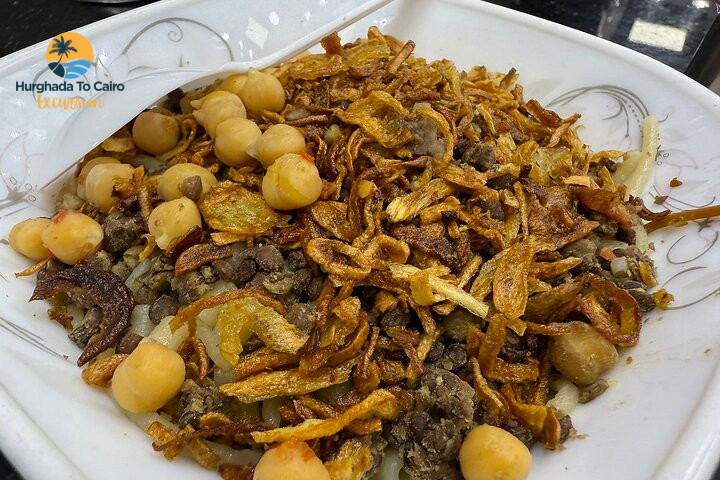
The definitive Egyptian street food. Layers of rice, lentils, short macaroni, and chickpeas, topped with crispy fried onions and served with two sauces: a spiced tomato-vinegar and a chilli oil. A product of 19th-century cosmopolitan Cairo — Italian pasta + Indian dal + Egyptian rice, all unified by local spicing. Order it at a dedicated koshary shop where nothing else is served: Abu Tarek on Champollion Street (open since 1950) is Cairo’s most famous. ~EGP 30–60 per bowl.
🫘
Ful Medames — The Ancient Breakfast
Egypt’s oldest dish. Slow-cooked fava beans, mashed and dressed with olive oil, cumin, lemon juice, and garlic — served with fresh bread. Eaten by Egyptians for at least 5,000 years (fava bean seeds were found in archaeological sites from 3000 BCE). The morning ful cart is an institution in every Cairo neighbourhood — and the guide knows exactly which street cart makes the finest version on today’s route. ~EGP 20–40 per serving.
🟢
Ta’amiya — Egyptian Falafel
Egypt’s version of falafel — and it is fundamentally different from every other. Made from fava beans rather than chickpeas, mixed with fresh herbs (coriander, parsley, dill, leek), and fried in a crust of sesame seeds. The interior is a vivid green rather than the brown of Levantine chickpea falafel. Served in bread with tahini and pickles. Cairo has been making ta’amiya differently from every other city in the Arab world for at least 1,000 years. ~EGP 5–10 per piece.
🥬
Molokhia — The Pharaoh’s Leaf
Egypt’s signature soup-stew. Made from the leaves of the jute plant (Corchorus olitorius), finely chopped and cooked in chicken or rabbit broth with garlic and coriander. The result is intensely flavoured with a characteristic viscous texture. Served over rice with bread and a squeeze of lemon. One of the most distinctively Egyptian dishes — the flavour is unlike anything else in world cuisine. Beloved by Egyptians across all social classes.
🥩
Hawawshi — Cairo’s Street Meat Sandwich
Cairo’s answer to a burger. Spiced minced meat (beef, lamb, or mixed) stuffed into bread dough and baked directly in a stone oven until the crust is blistered and the meat is fragrant with onion, pepper, and parsley. The best hawawshi in Cairo comes from dedicated shops near the old city gates — your guide knows the addresses. ~EGP 40–80 per sandwich.
🍰
Konafa — The Queen of Egyptian Sweets
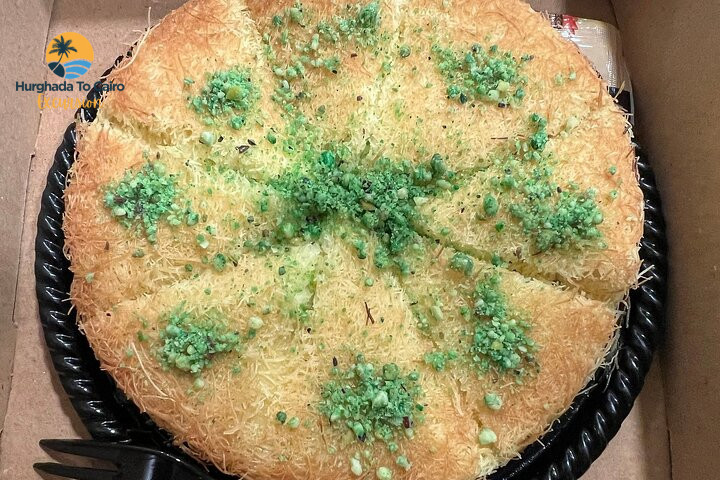
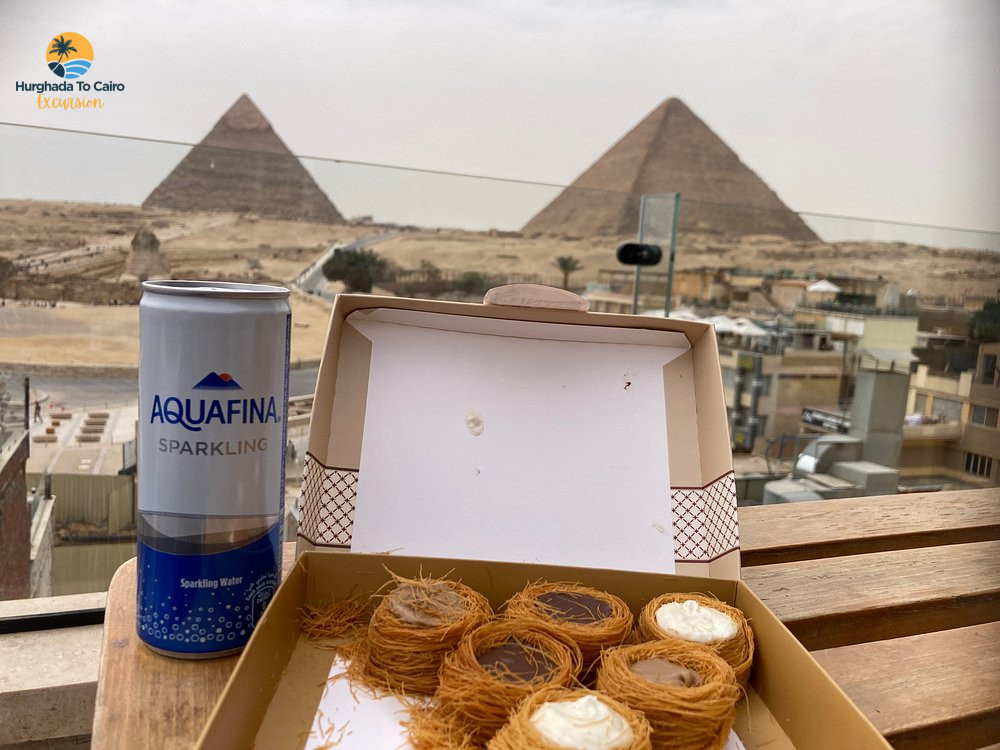
The greatest Egyptian dessert. Fine shredded wheat pastry (kunafe) layered over fresh white cheese or cream, soaked in rose-water syrup, and finished with crushed pistachios. The best konafa in Cairo is found in Khan El Khalili and the streets of Islamic Cairo — particularly from shops that have served the same recipe to the same neighbourhood for generations. Eaten warm, best consumed immediately. ~EGP 40–80 per portion.
🥙
Feteer Meshaltet — Pharaonic Pastry
The most ancient surviving Egyptian bread tradition. A multi-layered pastry made by folding butter or ghee repeatedly into a dough stretched almost transparent — producing a flaky, rich pastry that can be served sweet (with honey, jam, or cream) or savoury (with egg and cheese). Directly descended from ancient Egyptian bread-making techniques documented in Pharaonic tomb paintings. Watch it made and eat it immediately. ~EGP 30–60 per portion.
🍵
Shay bi Na’na — Egyptian Mint Tea
The social lubricant of Egyptian life. Strong black tea brewed in a glass, poured over a generous bunch of fresh mint leaves, sweetened with sugar. Served everywhere from street stalls to five-star hotels — but it reaches its finest expression at El-Fishawy Café in Khan El Khalili, where the same recipe has been served since 1773. ~EGP 15–25 per glass.
🥤
Asab — Sugarcane Juice
Cairo’s most refreshing street drink. Fresh sugarcane pressed on an electric roller on the pavement, producing a pale green juice that is simultaneously sweet, grassy, and intensely refreshing. The mobile asab cart is a fixture of every Cairo neighbourhood. Best consumed immediately after pressing on a warm afternoon. ~EGP 10–20 per cup.
🍹
Karkade — Hibiscus Tea
Egypt’s signature tisane. Dried hibiscus petals steeped in water and served hot or iced, producing a deep crimson drink that is simultaneously tart, floral, and intensely refreshing. Egypt is one of the world’s largest hibiscus producers — the flower is grown extensively in Upper Egypt. Iced karkade in summer is one of the finest drinks the Egyptian street offers. ~EGP 15–30 per glass.
10 Must-Taste Food Experiences on Your Cairo Tour
🍜
1. Koshary at Abu Tarek — Cairo’s Most Famous Bowl
Open since 1950, Abu Tarek on Champollion Street is a Cairo institution. Three floors of narrow tables, communal seating, and a kitchen that produces nothing but koshary — in quantities that defy imagination. The guide orders, the bowls arrive in seconds, the sauces are poured in the traditional sequence. Egypt’s national dish at its finest source.
🫘
2. Morning Ful & Ta’amiya — Street Cart Breakfast
The guide knows the specific street cart that makes the finest morning ful in the neighbourhood — a vendor who has been in the same spot for 30 years, whose slow-cooking technique produces ful of a consistency unmatched by any restaurant version. Eaten with fresh bread and a glass of tea. The most honest meal in Cairo.
🥙
3. Hawawshi from a Stone Oven
Watching a Cairo baker pull hawawshi from a wood-fired stone oven — the bread blistered and smoking, the filling fragrant with onion and pepper — is one of the great street food theatre moments of the city. Your guide takes you to a shop with a visible oven and a reputation in the neighbourhood. The sandwich is eaten standing, immediately.
🥩
4. Kofta & Grilled Meats — Khan El Khalili
The grill restaurants in and around Khan El Khalili produce kofta (spiced minced meat on skewers), grilled lamb chops, and charcoal-roasted chicken that have been the staple of the bazaar’s working population for centuries. The guide selects a genuine neighbourhood establishment rather than a tourist-facing restaurant — the quality difference is significant.
🍰
5. Konafa — The Khan El Khalili Dessert Trail
The guide leads a dedicated dessert trail through Khan El Khalili’s sweet shops — comparing three different konafa styles: the classic cheese konafa (billowy white cheese under shredded wheat), the cream konafa (qishta), and the nut-filled variety. The best konafa in Cairo comes fresh from ovens in this quarter. The trail takes 30 minutes and produces the clearest possible picture of why Egyptian sweets are extraordinary.
🥐
6. Feteer Meshaltet — Watch & Eat
Watching a feteer baker stretch the dough until it is almost transparent — building up 20, 30, 40 layers with butter between each — is one of Cairo’s great performance arts. The bakeries near Khan El Khalili allow spectators. The feteer is served immediately from the oven, sweet or savoury, and eaten with the fingers.
🤢
7. Sugarcane Juice — The Asab Cart Experience
The guide stops at a specific asab cart whose machine has been producing the same quality of sugarcane juice in the same Al-Hussein Square location for years. The juice is pressed to order — you watch the cane go in and the pale green liquid pour out. In warm weather (most of the year in Cairo), this is the most refreshing 5-minute pause of the day.
☕
8. Tea at El-Fishawy — Since 1773
The Cairo food tour ends where all great Cairo food experiences should end — at El-Fishawy café, open since 1773. Egyptian mint tea or cardamom coffee at a marble table surrounded by antique mirrors and brass lanterns. The guide narrates the café’s history and its famous regulars. The most atmospheric tea stop in the Arab world.
🥤
9. Karkade & Egyptian Drinks Tour
The guide introduces the full Egyptian drinks repertoire: iced karkade (hibiscus), tamr hindi (tamarind juice), sous (liquorice root), and the extraordinary summer drink sahlab (orchid-root milk thickened with cornstarch, topped with cinnamon, coconut, and nuts). Each drink tells a story about Egyptian agricultural traditions and trade routes.
🛒
10. Spice Market at Souk al-Attarin
The food tour concludes in the spice bazaar — where the guide identifies the spice blends used in every dish you have eaten during the day. Buying Egyptian saffron, cumin, ras el hanout, and dried karkade from the source, at the correct price with quality verified by your guide, is the finest souvenir possible from a Cairo food tour.
Full Day Itinerary — Cairo Food Tour from Hurghada Hour by Hour
Your private Cairo food tour from Hurghada follows this complete programme — designed to cover the full spectrum of authentic Egyptian cuisine from morning street food to evening café culture.
🚗
04:00 – 05:00 AM
Private Hotel Pickup — Hurghada, Marsa Alam & El Quseir
Your private air-conditioned vehicle collects you from your hotel lobby. Central Hurghada: 04:00 AM. El Gouna: 04:20 AM. Sahl Hasheesh: 04:30 AM. Makadi Bay: 04:45 AM. Soma Bay: 05:00 AM. Marsa Alam: 02:30 AM. El Quseir: 03:00 AM — contact us for custom pickup. Your Egyptologist guide travels with you from pickup — introducing the history of Egyptian cuisine, the story of each iconic dish you will encounter today, and the food geography of Cairo’s medieval city. Bottled water throughout.
⛰️
04:00 – 08:30 AM
Hurghada to Cairo — Private Transfer (~460 km)
4.5-hour drive via the Cairo–Suez desert motorway. The guide’s pre-visit food briefing during the drive covers: the Pharaonic origins of ful medames, the Ottoman influences on Egyptian meat traditions, the 19th-century cosmopolitan Cairo that produced koshary, and the medieval spice trade that built Khan El Khalili. By the time you arrive in Cairo, you already know the stories behind what you are about to eat.
🫘
08:30 – 09:30 AM
Morning Street Food Circuit — Ful, Ta’amiya & Asab ⭐⭐⭐
The food tour begins in the early morning streets of Islamic Cairo — the only time when the full morning street food culture is visible. The guide takes you to the specific ful cart that has been cooking in the same spot for 30 years, with slow-cooked fava beans reaching perfect consistency by 08:30. You eat standing — as Egyptians eat breakfast — with fresh bread, pickled vegetables, a drizzle of olive oil, and a squeeze of lemon. Then the ta’amiya fryer: green-herbed, sesame-crusted Egyptian falafel pressed into bread with tahini. Then the asab cart for freshly pressed sugarcane juice. Total: 3 dishes, 3 vendors, 60 minutes, and the clearest possible picture of how Cairo begins its day.
🕌
09:30 – 11:00 AM
Saladin Citadel & Al-Muizz Street — Food History Walk ⭐⭐
A 90-minute cultural and food history walk connecting the food tour to its historical context. The Saladin Citadel provides the panoramic view of Cairo — the guide pointing out the specific neighbourhoods where each food tradition is rooted. Al-Muizz Street provides the medieval food geography: the guide explains where the spice merchants, the bread bakers, the butchers, and the coffee houses stood in the Mamluk-era city — and how those positions are still occupied today. A cultural framework that makes the afternoon food stops significantly more meaningful.
🍜
11:00 AM – 12:00 PM
Koshary — Egypt’s National Dish at Its Source ⭐⭐⭐
Abu Tarek, open since 1950 — the most famous koshary restaurant in Egypt. Three floors of communal tables, no menu (there is only koshary), and a kitchen producing Egypt’s national dish in perfect form. The guide orders, narrates the dish’s extraordinary 19th-century origin story (Italian pasta + Indian dal + Egyptian rice + Levantine chickpeas, all unified by a local sweet-spiced tomato-vinegar sauce), and shows you the correct sauce-adding sequence. The bowl that arrives is a complete narrative of 19th-century Cairo’s multicultural food history in a single dish.
🥙
12:00 – 13:00 PM
Hawawshi & Molokhia Lunch — Neighbourhood Restaurant ⭐⭐
A quality sit-down lunch at a genuine neighbourhood restaurant in Islamic Cairo — the kind patronised exclusively by local residents and never reviewed in any tourist publication. The menu covers: hawawshi from the stone oven, molokhia soup with bread, grilled kofta with tahini, and rice dishes that define the midday meal in Cairo. The guide explains each dish’s cultural significance before you eat. This meal — unremarkable by Cairo standards, extraordinary by any international comparison — is included in your tour price.
🥐
13:00 – 14:00 PM
Feteer Meshaltet — Watch the Baker & Eat Immediately ⭐⭐
The afternoon food circuit begins at a dedicated feteer bakery — where the guide introduces you to the baker and you watch the 20-layer pastry being assembled with butter and folded to paper-thinness before your eyes. The feteer is placed in the oven while you watch, and eaten the moment it emerges — sweet with honey and cream. The guide narrates the connection between modern feteer and the multi-layered bread tradition documented in ancient Egyptian tomb paintings. A living piece of Pharaonic food history.
🍰
14:00 – 15:00 PM
Khan El Khalili Dessert Trail — Konafa, Qatayef & Om Ali ⭐⭐⭐
The guide leads a dedicated dessert circuit through the sweet shops of Khan El Khalili. Three stops: (1) Classic cheese konafa at a shop that has served the same recipe to this neighbourhood for generations — pulled hot from the oven, soaked in rose-water syrup, finished with pistachios. (2) Qatayef — small pancakes filled with nuts or cream, folded and fried, soaked in syrup — the signature dessert of Ramadan and special occasions. (3) Om Ali — Egypt’s extraordinary bread pudding: torn feteer, soaked in sweetened milk, baked with coconut, raisins, and nuts. The finest Egyptian dessert you have never heard of.
🌶️
15:00 – 15:45 PM
Souk al-Attarin — The Spice Bazaar & Taste the Ingredients ⭐⭐
The Souk al-Attarin (spice bazaar) is the food tour’s final teaching stop — where the guide connects every spice you have encountered in the day’s dishes to its source: the cumin in the ful, the coriander in the ta’amiya, the cinnamon in the Om Ali, the rose water in the konafa, the hibiscus of the karkade. The guide verifies quality and negotiates fair prices for anyone buying to take home. The spice market is the supply chain of the entire day’s food — experiencing it last, rather than first, makes it revelatory.
☕
15:45 – 16:15 PM
El-Fishawy Café — The Perfect Ending Since 1773
The food tour closes where every great Cairo food experience should close — at El-Fishawy. The guide secures a table in the lantern-lit interior. Egyptian mint tea or cardamom coffee is ordered. The guide narrates the café’s 253-year history, its literary regulars (Naguib Mahfouz wrote his Nobel-winning novels at these tables), and its role as Cairo’s most enduring social institution. Then simply: rest, drink slowly, and absorb the sounds of Khan El Khalili from the most atmospheric seat in the city.
🚗
16:15 – 20:45 PM
Private Return Transfer to Hurghada
Your private vehicle returns you directly to your Hurghada hotel — door to door, no shared stops. Return drive approximately 4.5 hours. Arrive back ~20:45–21:15. Marsa Alam guests: ~21:30. El Quseir guests: ~21:15. Bottled water throughout.
Private · Licensed Guide · All Food Included · No Shopping Pressure
Secure your private Cairo food tour from Hurghada — koshary, ful, ta’amiya, konafa, feteer, and El-Fishawy tea in one extraordinary day of authentic Egypt.
🍽️ Book Cairo Food Tour — From €125 Per Person
Free cancellation up to 24 hours before departure
Tour Quick Facts — Duration, Pickup Times & Languages
📋 Tour at a Glance
DurationFull day (~17 hrs door to door)
Pickup (Hurghada)04:00–05:00 AM
Pickup (Marsa Alam)02:30 AM (contact us)
Pickup (El Quseir)03:00 AM (contact us)
Return to Hurghada~20:45–21:15 PM
LanguagesEnglish · French · German · Spanish
Group SizePrivate — your group only
Minimum2 adults (solo +25% supplement)
⏰ Pickup by Location
Central Hurghada04:00 AM
El Gouna04:20 AM
Sahl Hasheesh04:30 AM
Makadi Bay04:45 AM
Soma Bay05:00 AM
El Quseir03:00 AM (contact us)
Marsa Alam02:30 AM (contact us)
2026 Pricing — Cairo Food Tour from Hurghada Cost
Best Value
Private Car Food Tour
€125
per adult · ~£107
✓ All Food Stops · ✓ Guide · ✓ Drinks
Children under 12: €70 · Solo: +25%
By Flight — Extended Food Day
€315
per adult · ~£270
✓ Return flights · ✓ 3 extra food hours · ✓ Nile dinner option
Children under 12: €190
Shared Bus Tour
€50
per adult · ~£43
Shared coach · Group guide · 1 food stop only
Not recommended for food tour focus
✅ Included
✓ Private round-trip vehicle (your group only)
✓ Licensed English-speaking Egyptologist guide
✓ Morning street food circuit (ful, ta’amiya, asab)
✓ Koshary at Abu Tarek (Egypt’s national dish)
✓ Main lunch (hawawshi, molokhia, kofta)
✓ Feteer meshaltet (sweet, from the oven)
✓ Khan El Khalili dessert trail (konafa, qatayef, Om Ali)
✓ All drinks at food stops (tea, karkade, asab)
✓ El-Fishawy café stop (tea/coffee)
✓ Saladin Citadel entrance (food history context)
✓ Bottled water throughout + free cancellation 24hrs
❌ Not Included
✕ Tips for guide and driver (€10–15/person, optional)
✕ Additional personal food purchases beyond the programme
✕ Spice market purchases (your budget)
✕ Alcoholic beverages (Egypt is predominantly dry)
💡 Dietary Notes
All food stops in the programme are naturally halal. Egyptian street food is significantly vegetarian-friendly — ful, ta’amiya, koshary, konafa, and feteer are all meat-free. Our guide adapts the programme for any dietary requirements including vegetarian, vegan, gluten-free, and nut allergies. Mention at booking.
Private Food Tour vs Group Bus — Full Comparison
| Feature |
Private Food Tour |
Group Bus Tour |
| Food stops |
✓ 8–10 stops across the full day |
1 group lunch only |
| Morning street food |
✓ Ful + ta’amiya + asab — all included |
Never included |
| Konafa dessert trail |
✓ 3 dessert stops — all included |
Never included |
| Food history context |
✓ Full Egyptologist explanation at each stop |
None |
| Dietary adaptation |
✓ Fully adaptable — vegetarian, vegan, allergies |
Fixed menu |
| Price per person |
From €125/adult |
From €50/adult |
| Best for |
Food lovers, culinary travellers, anyone serious about food |
Budget travellers for whom food is not the priority |
10 Insider Food Tips from Our Guides
Tip 1 — Eat the morning ful standing up, as Egyptians do. The culture of ful consumption in Cairo is specifically a standing-up street experience. Eating it at a table in a restaurant produces a different (and inferior) result — both because the food is less fresh and because the social context is absent. The guide will take you to the specific cart where breakfast in Cairo actually begins, and you eat it exactly as it has been eaten on this corner for 30 years.
Tip 2 — The koshary sauces are added in a specific order — learn the sequence. Proper koshary consumption is sequential, not simultaneous. First the tomato-vinegar sauce, in moderate quantity. Then the chilli oil — a small amount unless you are experienced with Egyptian chilli heat. Then stir from the bottom up, incorporating all layers. If a koshary shop adds the sauces without asking you, you are eating at a tourist-oriented establishment. At Abu Tarek, the waiter brings both sauces separately and expects you to manage them yourself.
Tip 3 — The best konafa in Cairo is eaten at the shop window, not carried away. Konafa at its finest — the cheese version — is a hot dessert. The moment it begins cooling, the cheese stiffens and the texture changes. The best experience is to order at the window, receive the portion directly from the oven, and eat immediately on the street with a small plastic fork. Your guide times the dessert circuit to ensure this is how all three stops are experienced.
Tip 4 — Ask the feteer baker to make yours sweet rather than savoury. Feteer meshaltet can be either sweet (with honey, cream, jam) or savoury (with egg and white cheese). For a food tour context, the sweet version — eaten as a midday pastry rather than a meal — showcases the technique most dramatically. The honey and cream version fresh from the oven is extraordinary. Ask the guide to specify helw (sweet) when ordering.
Tip 5 — Egyptian ta’amiya is made from fava beans, not chickpeas — this matters. The distinction between Egyptian ta’amiya (fava bean, green-herbed) and Levantine falafel (chickpea, beige inside) is not a trivial variation — they are fundamentally different foods. Egyptian ta’amiya is significantly more herbal, more complex in flavour, and more vibrantly coloured. If the ta’amiya you are offered is beige inside rather than vivid green, you are eating Lebanese or Syrian falafel. Your guide ensures you eat the authentic Egyptian version.
Tip 6 — Drink the karkade iced, not hot, in warm weather. Hibiscus tea served iced is one of the most refreshing drinks available in Cairo during the warmer months (April–October). The tartness of the karkade counteracts heat fatigue in a way that water alone cannot. Your guide requests iced versions at the appropriate stops and introduces you to the other cold Egyptian drinks — tamarind juice (tamr hindi) and liquorice root water (sous) — that are served by street vendors in the Al-Hussein Square area.
Tip 7 — Om Ali is the dessert most visitors to Egypt never taste — insist on it. Om Ali (literally “mother of Ali”) is Egypt’s finest dessert by any objective measure — a bread pudding made from torn feteer, baked in sweetened milk with coconut, raisins, pistachios, and almonds, served hot with a browned cream surface. It is named after the wife of a 13th-century Mamluk sultan and has been a fixture of Egyptian royal and then popular cooking ever since. Your guide includes it on the dessert trail specifically because it is almost unknown to international visitors.
Tip 8 — The best spices to bring home from the Souk al-Attarin are the ones that are hardest to find genuine outside Egypt. Our guides consistently recommend: (1) Egyptian saffron — test by smell and colour rather than price (genuine Egyptian saffron is intensely fragrant; dyed safflower is not). (2) Dried karkade hibiscus — the Egyptian quality is significantly superior to any imported product available in UK supermarkets. (3) Ras el hanout — the North African spice blend that Egyptian cooks use as a base for stew cooking. (4) Dried molokhia leaves — the closest thing to a ready-made Egyptian ingredient you can take home.
Tip 9 — El-Fishawy is best experienced in the interior rooms, not the outside tables. El-Fishawy’s outdoor tables face the busy Khan El Khalili alley — atmospheric but noisy. The interior rooms — with their antique mirrors, brass lanterns, and marble tables — are where the café’s literary history was made. Your guide secures a table in the inner rooms. If Naguib Mahfouz ever sat at your table, your guide will tell you.
Tip 10 — Eat everything offered — the portions are deliberately smaller than restaurant servings. The food tour is structured around multiple small tastings rather than full meal portions at each stop. This is intentional — it allows you to taste everything without becoming too full to continue. If you eat everything offered, you will finish the day comfortably satisfied rather than overfull. If any dish is genuinely not to your taste, no offence is taken — simply leave it.
Real Reviews — Cairo Food Tour from Hurghada
★★★★★
“I have done food tours in Bangkok, Mexico City, and Istanbul. The Cairo food tour from Hurghada is the best I have ever done — not because of the food itself (though the konafa and the morning ful were extraordinary) but because the historical context our guide provided made every dish a revelation. I now understand Egypt through its food in a way I could never have from visiting monuments alone.”
Caroline & Ian M. — London, UK · May 2026
★★★★★
“We came from Marsa Alam — yes, the 2:30 AM pickup was brutal. Worth every minute. The koshary at Abu Tarek was the single best thing I ate in Egypt. The Om Ali at the Khan El Khalili dessert shop was a close second. Our guide knew the story of every dish and every vendor. El-Fishawy at the end was perfect. I would do this again immediately.”
David & Fiona W. — Manchester, UK · April 2026
★★★★★
“I am vegetarian and was worried the Cairo food tour wouldn’t work for me. It was perfect — ful, ta’amiya, koshary, feteer, konafa, and Om Ali are all naturally meat-free. Our guide had adapted the programme before we arrived and knew exactly which vendors to take me to. The spice market at the end was extraordinary — I came home with more saffron than anything else.”
Sarah T. — Edinburgh, UK · March 2026
Combine with Other Tours — Suggested Multi-Day Itineraries
The Cairo food tour from Hurghada pairs naturally with Egypt’s wider journey — from Luxor’s ancient temples to Abu Simbel’s rock-cut monuments and the Red Sea coast from Hurghada to Marsa Alam.
🍽️ → 🏺 → 🌅
Hurghada → Cairo Food Tour → Luxor
Day 1: Cairo Food Tour from Hurghada — koshary, ful, konafa, and El-Fishawy.
Day 2–3: Luxor 2-day private tour — Karnak, Valley of the Kings, Luxor Temple by night. Experience
authentic Egyptian food culture first, then the monuments that inspired it — the sequence that Egyptian writers and artists themselves recommend.
View Luxor Tours →
🍽️ + 🏔️ + 🏛️
2-Day Cairo: Pyramids + Food Tour
Day 1: Giza Pyramids + Grand Egyptian Museum.
Day 2: Cairo Food Tour — full day of authentic Egyptian cuisine. Our
2-day Cairo private tour with 5-star hotel covers both days. Egypt’s greatest monuments and greatest food in two extraordinary days — from €225/person.
🍽️ → 🌅 → 🏺
Cairo → Luxor → Abu Simbel
The classic Egypt loop: Cairo food tour (Day 1) → Luxor 2-day tour with hotel (Day 2–3) → Abu Simbel flight day tour from Luxor (Day 4). Contact us to arrange the full multi-destination Egypt itinerary — we coordinate all pickups, hotels, and guides across the journey.
🌊 → 🍽️ → 🐠
Hurghada → Cairo Food Tour → Marsa Alam / El Quseir
Staying anywhere on Egypt’s Red Sea coast? We pick up from
Marsa Alam (~02:30 AM) and
El Quseir (~03:00 AM) for the
Cairo food tour.
Contact us on WhatsApp with your hotel name for a custom pickup schedule and pricing.
🔗 Continue Your Egypt Journey
Book Your Cairo Food Tour Today
Secure your private Cairo food tour from Hurghada — koshary, ful medames, ta’amiya, konafa, feteer meshaltet, Om Ali, and El-Fishawy tea in one extraordinary day of authentic Egyptian cuisine. All food included. Licensed Egyptologist guide. Pickup from Hurghada, Marsa Alam, El Quseir, and all Red Sea coast hotels.
🍽️ Book Cairo Food Tour — From €125 Per Person
Final Thoughts — Why Tasting Egypt Is the Best Way to Understand It
Egypt has 7,000 years of recorded history — but much of it lives not in museums but in the street kitchens where ful medames has been cooked since the time of the Pharaohs, in the bread ovens where feteer meshaltet continues a technique documented in ancient tomb paintings, in the coffee houses where Egyptian cardamom coffee has been served to scholars and merchants since the Ottoman period.
The Cairo food tour from Hurghada gives you access to this living history in the most direct and pleasurable way possible: by tasting it. With a licensed Egyptologist guide who understands both the culinary and the historical dimensions of each dish, the food tour becomes one of the most comprehensive and memorable single-day introductions to Egyptian culture available anywhere in the country.
Book your private Cairo food tour from Hurghada today — and taste the Egypt that five millennia of cooks have been perfecting.
Frequently Asked Questions
Can you do a day trip to Cairo from Hurghada for a food tour?
Yes — a day trip to Cairo from Hurghada for the Cairo food tour is entirely feasible and the format works extremely well. The private car option (04:00 AM pickup, 4.5-hour drive) delivers you in Cairo by 08:30 AM for the morning street food circuit, and the food tour programme fills the day until 16:15 PM, with a return to Hurghada by ~21:00. The by-flight option (40 minutes) adds 3 extra hours — ideal for adding an evening food market circuit. All food stops in the programme are included in your tour price.
How much is a trip from Hurghada to Cairo for the food tour?
The private car Cairo food tour from Hurghada starts from €125 per adult (~£107) — including the Egyptologist guide, private vehicle, all food stops (morning street food circuit, koshary, lunch, feteer, konafa dessert trail, spice market tastings), all drinks (tea, karkade, sugarcane juice), and El-Fishawy café. Children under 12: €70. By-flight option from €315. Group bus from €50 (but only 1 food stop). See full pricing at hurghadatocairo.com.
What food is Hurghada, Egypt known for?
Hurghada is known primarily for fresh Red Sea fish — sea bream, grouper, red mullet, and calamari grilled at harbour-front restaurants. This is the authentic local Red Sea coastal cuisine. What Hurghada is not known for is the deep street food tradition of Cairo: koshary, ful medames, ta’amiya, konafa, and feteer. The Cairo food tour from Hurghada bridges this gap — taking you from the coast to the city that has been refining Egyptian cuisine for 1,400 years.
What is the biggest food festival in Egypt?
Egypt’s biggest food event is Ramadan — not a formal festival but a month-long transformation of the country’s food culture. The streets of Cairo fill with Ramadan food markets (mawaid al-rahman), thousands of open tables feed anyone who passes, and the sunset iftar becomes the most important meal of the year. Ramadan-specific foods — konafa, qatayef, Om Ali, fattah — reach their finest expression during this period. The Khan El Khalili food market during Ramadan evenings is one of the most spectacular food experiences in the Arab world. The formal Cairo Food Festival takes place annually in November, showcasing Egyptian regional cuisine across multiple venues.
Is the Cairo food tour suitable for vegetarians?
Yes — the Cairo food tour is exceptionally well-suited for vegetarians. Egypt’s most iconic dishes are predominantly plant-based: ful medames (fava beans), ta’amiya (fava bean falafel), koshary (lentils, rice, pasta, chickpeas), konafa (cheese or cream), feteer meshaltet (sweet version), Om Ali (bread, milk, nuts), and all the drinks. Vegetarians can experience the full programme without any substitution. Vegans can be accommodated with some minor adaptations — mention at booking. Gluten-free options are more limited but available for the main dishes.
Can travellers from Marsa Alam and El Quseir join the Cairo food tour?
Yes — we offer pickup from
Marsa Alam (~02:30 AM) and
El Quseir (~03:00 AM) for the
Cairo food tour from Hurghada. The earlier pickup delivers the same full day in Cairo. Contact us at
WhatsApp +20 100 925 5585 with your hotel name for a custom pickup schedule and pricing confirmation. A small distance supplement may apply for hotels south of Hurghada.
What is koshary and why is it Egypt’s national dish?
Koshary is Egypt’s national dish — layers of rice, brown lentils, short macaroni, and chickpeas topped with crispy fried onions, served with a spiced tomato-vinegar sauce and chilli oil. It became Egypt’s national dish through a remarkable food history: Italian migrant workers brought pasta to Cairo during the 19th-century canal construction era; Indian workers from the British colonial administration contributed the lentil-rice combination; Egyptian cooks unified them with local spicing and tomato. The result is a dish that tells the entire story of 19th-century cosmopolitan Cairo in a single bowl — and costs approximately EGP 30–60 (~50p) per serving. On your tour you eat it at Abu Tarek on Champollion Street — open since 1950, Cairo’s most famous koshary establishment.
How does the Cairo food tour combine with a Luxor tour or Abu Simbel?
The most popular multi-day combination is:
Day 1 —
Cairo food tour from Hurghada (return by ~21:00).
Day 2–3 —
Luxor 2-day private tour from Hurghada with hotel stay (Karnak, Valley of the Kings, Luxor Temple by night). Adding Abu Simbel requires a day trip from Luxor — our guides can arrange the full Luxor → Abu Simbel itinerary. Contact us for custom multi-destination Egypt planning across any number of days.