If mobility, fitness, or simple planning is on your mind before a Cairo day trip, knowing roughly how much walking to expect at each stop makes a genuine difference to how you prepare. This guide breaks the day down site by site — the Giza Plateau, the Grand Egyptian Museum, and the older Egyptian Museum in Tahrir Square — with honest, clearly labelled estimates, plus practical advice on footwear and rest.
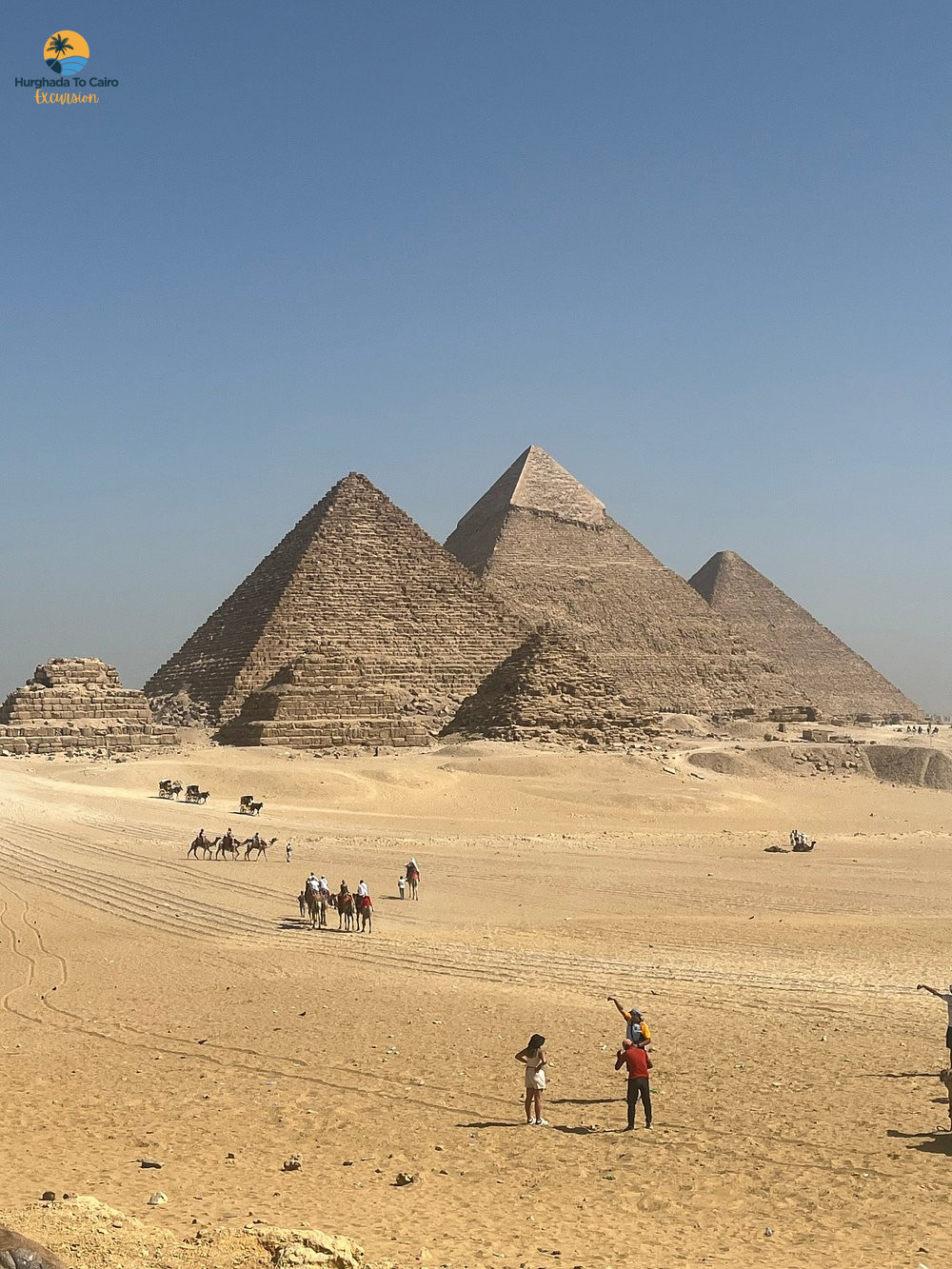
Walking at the Pyramids of Giza
The Giza Plateau is open desert terrain — sandy, uneven in places, and with no paved network connecting every viewpoint. A typical guided visit involves walking between the main viewing area in front of the Great Pyramid, over toward the Sphinx enclosure, and around the base of at least one pyramid for photographs, which realistically adds up to somewhere around 1-2 km for most visitors. That figure rises further if you choose to enter one of the pyramid interiors, which adds a steep, narrow, low-ceilinged climb entirely separate from the outdoor walking. Ground underfoot is genuinely uneven, so this is not a flat, easy stroll even before distance is considered.
If minimising walking at Giza specifically matters to you, our Cairo Tour from Hurghada for Seniors is built around keeping total walking at the plateau under 200 metres, by repositioning the vehicle between viewpoints rather than walking the full distance on foot.
Walking at the Grand Egyptian Museum
The Grand Egyptian Museum is genuinely vast — roughly 45,000 square metres of exhibition space spread across a 500,000 square metre complex, with 12 chronological galleries plus the Tutankhamun halls, the Grand Staircase, and a separate building housing the Khufu Solar Boat. Multiple visitor guides describe the “distances between galleries” as real and worth planning for, rather than a minor detail. A focused 3-4 hour visit covering the highlights typically involves at least 1.5-2.5 km of walking on flat, smooth, climate-controlled floors — genuinely easier underfoot than Giza’s sand, but a longer total distance if you explore thoroughly. A fuller half-day visit taking in most of the 12 main galleries can realistically add up to considerably more.
The good news is that GEM’s walking is on level, paved ground throughout, with seating available in most galleries and lift access to every floor — a genuinely different walking experience from the Giza Plateau’s uneven sand.

Walking at the Egyptian Museum, Tahrir Square
By comparison, the older Egyptian Museum in Tahrir Square is considerably smaller — around 13,600 square metres, versus GEM’s much larger footprint — and a typical visit lasts only 2-3 hours. Walking distance here is genuinely more modest, likely in the region of 0.5-1 km for a standard visit, though the building’s age means some stairs and less even flooring compared to GEM’s purpose-built, modern design.
Putting It Together: A Typical Full Day
| Stop | Estimated Walking | Terrain |
|---|---|---|
| Giza Plateau | ~1-2 km | Sandy, uneven, open desert |
| Grand Egyptian Museum | ~1.5-2.5 km | Flat, smooth, indoor |
| Egyptian Museum (Tahrir) | ~0.5-1 km | Mostly flat, some stairs |
A standard tour combining the Pyramids and GEM, plus a short walk to and from the restaurant for lunch, typically lands somewhere around 3-5 km total across the full day — spread over many hours with long periods sitting in the vehicle between stops, rather than continuous walking.
If You’re Travelling as a Senior, or With Mobility Concerns
If the totals above feel like more than you’d want to manage, you have genuine alternatives rather than skipping Cairo altogether. Our Cairo Tour from Hurghada for Seniors is built specifically around minimal walking, real rest stops, and vehicle-to-viewpoint access at Giza, without compromising on time at either the Pyramids or GEM. And if you use a wheelchair, our Wheelchair Accessible Cairo Tour from Hurghada gives an honest, site-by-site breakdown of what’s genuinely accessible, with a ramp-equipped vehicle arranged in advance.
Footwear That Actually Helps
Because the day mixes uneven desert sand with smooth indoor flooring, the most useful shoe is a well broken-in, closed, supportive walking shoe rather than sandals or anything with a heel. Genuinely worn-in trainers or walking shoes handle both surfaces far better than footwear chosen for one environment alone.
Where You Can Rest
Rest opportunities exist at every stage of the day. GEM has seating positioned throughout its galleries, so a pause is never far away. The Giza Plateau has shaded viewing areas near the main vehicle drop-off points. And the drive itself — several hours each way — gives genuinely long periods to sit and recover between the more active parts of the day. Don’t hesitate to ask your guide for extra breaks; a well-planned Cairo day trip has flexibility built in specifically for this.
Frequently Asked Questions
Find the Right Cairo Tour for Your Pace
Whether you want the full standard day, a senior-comfort itinerary with minimal walking, or a genuinely wheelchair accessible trip, we have an option built around your real needs.